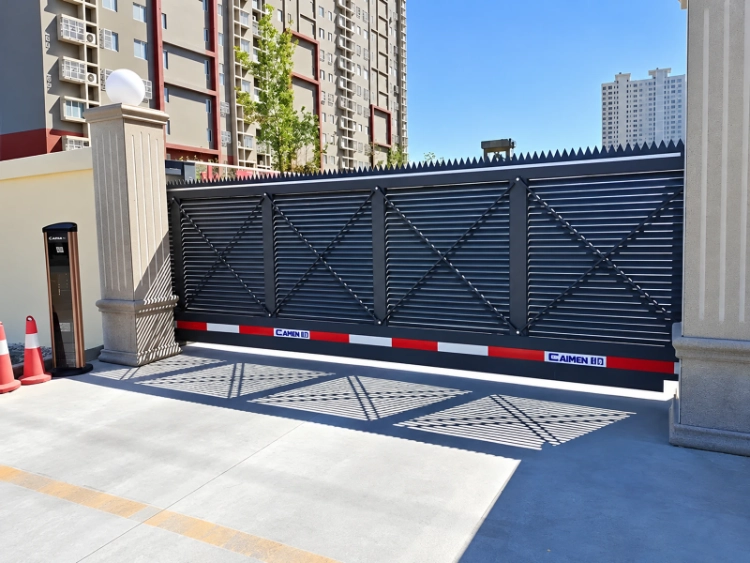
Why Does the Foundation Decide Whether a Trackless Cantilever Gate Runs Reliably?
 FACEBOOK
 TWITTER
 LINKEDIN
A trackless cantilever gate does not rely on a rail across the driveway. Instead, the weight of the gate leaf and rear counterbalance, together with the forces created during starting and stopping, is transferred through the carriages, support posts and anchors. If the foundations settle or the posts move out of alignment, the effects can appear quickly: the gate may scrape, clearances may become uneven, movement may feel strained, or the leaf may fail to reach its end position.
For warehouses and industrial entrances, foundation and anchorage requirements should be specified alongside the gate leaf and drive system. Even a well-manufactured gate can perform poorly if the supports are allowed to shift after installation.
The Short Answer
Reliable operation depends on stable support geometry, not simply on motor power. The foundation must resist vertical, lateral and overturning forces, and the posts must remain plumb after paving and drainage work is complete. The rear counterbalance needs a clear travel path. The beam and carriages must suit the opening, infill, wind exposure and frequency of use. Safety devices must also cover the finished vehicle and pedestrian routes.
A ground rail across a busy entrance can collect mud, gravel, snow and other debris. Removing that rail reduces one maintenance concern, but it does not eliminate maintenance: attention shifts to the carriages, guides, posts, sensors and drainage around the foundations.
Why the Foundation Sees More Than a Downward Load
The carriages of a suspended gate do more than support its weight. Acceleration and braking also create horizontal forces, while wind introduces additional lateral loads, especially with solid privacy panels rather than open picket infill. The foundations must both carry these changing loads and keep the moving components correctly aligned.
The rear counterbalance needs room
The clear opening is the space vehicles pass through, but the rear counterbalance extends along the fence line and transfers bending forces to the carriages and supporting structure. Site drawings should show the full runback, gate height, infill, service access, adjacent walls and fences, drains, trailer routes and pedestrian areas, not just the space between the entrance posts.
A common oversight is to measure the entrance opening without allowing for the rear tail. The gate may fit neatly between the posts but meet a fence return, wall or parked equipment before it has opened fully.
Alignment cannot be corrected with a stronger motor
If a support post settles or rotates, the beam and carriages can no longer share the load as designed. The motor may continue to move the gate, but the increased friction and side loads place additional strain on the rollers, bearings, anchors and frame.
Before adjusting the carriages or installing a more powerful motor, check the foundation and post alignment. A stronger drive might overcome the resistance for a time, but it cannot correct the underlying problem.
What a Trackless System Changes at the Site
The CAIMEN cantilever sliding gate system operates above the driveway without a continuous ground rail. Aluminum structural sections, a cantilever beam and roller carriages support the moving gate. Beam profiles and carriage arrangements can be selected to suit the opening size and the loads expected in service.
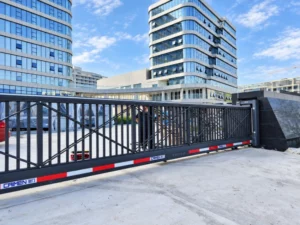
Removing the ground rail keeps a common debris trap out of the vehicle path, but regular inspection is still essential. Carriages, rollers, guides, posts, fasteners, sensors and foundation drainage all need attention. A clear driveway does little good if anchors are obstructed or a support post has settled out of plumb.
The absence of a rail does not make the foundations any less important. Although the gate leaf can travel over uneven pavement, the posts must be correctly positioned, aligned and securely supported. Responsibilities should be agreed early: who checks the soil and concrete, provides loading and anchor details, verifies carriage alignment, protects the finished surfaces and keeps service areas accessible?
Specify the Beam and Carriages Against the Real Opening
The panel is the most visible part of the gate, but the cantilever beam and carriages carry its structural loads. Heavier infill increases bending demands, while coastal or high-wind sites require allowance for additional lateral forces. Operating duty also matters. At a busy distribution yard, frequent cycles can increase heat and wear in the moving components.
Treat beam profiles as a configuration decision
CAIMEN offers 6005-T6 aluminum cantilever beam profiles in a range of cross-sections and wall thicknesses. Choosing the right profile depends on the gate dimensions, infill type and expected loads. The carriage arrangement shown above includes top, bottom and side rollers to carry vertical loads and limit lateral movement.
These choices should be documented in the purchase specification, including the beam profile, carriage arrangement, clear opening and overall gate dimensions. The specification should also cover infill, finish, drive system, supply voltage, access-control interface and safety devices.
Put the duty assumption in writing
Entrance width alone does not determine how often or how hard a gate will operate. Specify the expected cycles during the busiest hour, supported gate mass, travel speed, overload and thermal protection, manual release, operating temperature and weather limits. Confirm spare-parts availability and service support as well.
For the configuration described here, the reference figures are 500 W motor power, 18–22 m/min travel speed and 110 V or 220 V AC supply. Confirm the selected model’s specifications and suitability for the site before issuing the final request for quotation.
What to Record at Handover
Handover involves more than confirming that the gate opens and closes. The record should also reflect the completed entrance, including final paving levels, drainage, signs and traffic-control equipment.
Check the finished geometry
Record post plumbness and spacing, beam level, clearances beneath the leaf and counterbalance, and the fully open and closed positions. Check anchors, fasteners and support areas, and confirm that water drains away from the foundations. Repeat these checks after final surfacing, since temporary construction levels can hide clearance or drainage problems.
Test the safety path, not only the drive
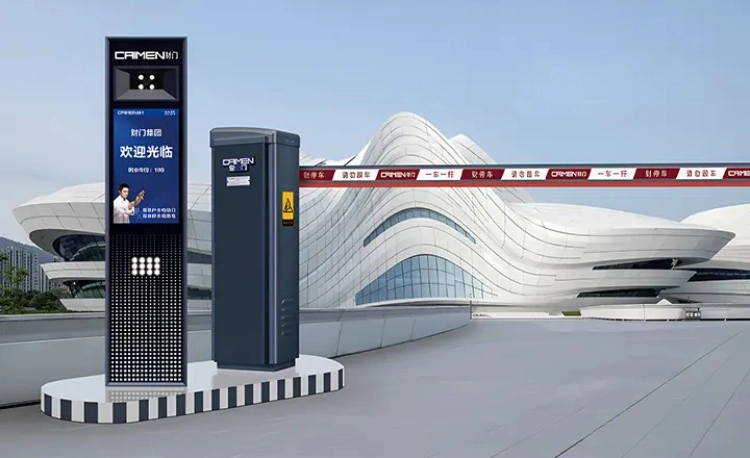
The described system includes infrared detection, a pressure-sensitive safety edge, mechanical anti-pinch protection, a warning indicator, emergency stop and manual release. Test each feature in its installed position. Check the response when the infrared beam is interrupted or the safety edge is activated, then test power loss and manual release. After restoring power, confirm that the gate does not restart unexpectedly. Test with representative vehicles nearby, as finished surfaces and site conditions can affect sensor coverage.
When a Trackless Cantilever Gate Is the Wrong Fit
A trackless cantilever gate may not be suitable where there is insufficient space for the rear counterbalance or where sound foundations cannot be constructed. At compact entrances, a folding gate may work better because its movement envelope can be shorter than the long, straight runback needed by a cantilever gate.
Compare an industrial bi-folding gate in terms of its full movement envelope, hinge and support loads, safety clearances, operating duty and service access. Looking only at equipment price can overlook later changes to fencing, drainage, traffic lanes or foundations.
CAIMEN’s completed gate projects show how different entrance needs are addressed in practice. Its wider range of entrance-control solutions also offers alternatives when a cantilever gate is not the best fit. To discuss a particular installation, contact the CAIMEN teamwith the site plan, opening width, gate height, infill, runback, traffic needs, power supply, foundation details and controls. This helps coordinate the gate design, civil work and access control from the outset.
FAQ
Does a trackless cantilever gate still need a concrete foundation?
Yes. Although there is no continuous rail across the driveway, the moving gate still transfers its loads through the carriages and posts into the foundations. Soil conditions, concrete, reinforcement, anchors, drainage and final driveway levels must all be assessed for the specific site.
Can a cantilever gate work at a gravel or uneven entrance?
Yes, depending on the site. Without a ground rail, gravel, debris and uneven paving may have less effect on gate movement. The foundations must remain stable, and the rear counterbalance route, carriages, sensors and maintenance areas must stay clear and accessible.
What information should accompany a cantilever gate quotation?
Provide the clear opening, gate height, infill type, available runback, site plan, local wind and weather conditions, expected operating cycles, power supply, foundation details, access-control needs and safety requirements. These details help determine the most suitable beam, carriages, drive and controls for the project.