How Do Fold Ratio and Hinge Geometry Determine Bifolding Gate Clearance?
 FACEBOOK
 TWITTER
 LINKEDIN
Fold ratio and hinge offsets determine the swept envelope of every leaf, so a gate can achieve the nominal opening width yet still strike a wall, vehicle, pedestrian zone, or operator mechanism. A bifolding gate reduces the space needed for a full-length swing leaf by dividing movement between linked sections. That benefit comes from geometry, not simply from adding a second panel. Fold ratio, hinge position, leaf width, post depth, operator linkage, vehicle clearance, and safety zones determine whether the gate opens as expected.
A driveway drawing should show the gate closed, partly open, and fully open. The outer edge of a folded leaf can travel differently from the hinge line. Vehicles, pedestrians, walls, lighting, readers, drainage, and landscaping must remain clear through the whole cycle.

Calculate the Moving Envelope From the Hinges Out
Start with the clear opening, then add posts, hinges, stops, seals, operators, and the finished gate surface. Measure the distance available behind and beside the opening. A gate can fit the wall gap while striking a parked vehicle or reducing a turning path when its leaves fold. Build the clearance check from the actual hinge axes, leaf thickness, posts, hardware projections, ground slope, deflection, and installation tolerance.
Fold Ratio Changes the Clearance Pattern
Equal leaves and unequal leaves create different arcs. The hinge between leaves may move inward or outward depending on the linkage. The selected fold ratio also changes the speed and force required from the operator. Draw the actual centerlines and edge profiles rather than estimating from the opening width alone.
Wind load changes during movement. A folded gate presents a different projected area from a closed gate, and a partly open position can catch gusts unevenly. Foundations, posts, hinges, stops, and operator forces should be checked for the selected leaf arrangement and local exposure.
Keep People Outside the Folding Zone
A vehicle gate may be used by pedestrians even when a separate entrance exists. The safety design should identify the moving envelope, pinch points, closing edges, hinge zones, and places where a person could stand unseen by a single photocell. Safety edges, photocells, radar, loops, and warning devices need coverage suited to the approach and traffic speed.
A detector placed too close to the gate may identify a vehicle only after the leaves begin moving. A detector placed too far away may hold the gate open unnecessarily. Test approach, stop, reverse, tailgating, and pedestrian crossing behavior, then document the logic so operators do not bypass a nuisance alarm.
Review the XFZD-X2 Against the Site Drawing
The XFZD-X2 Bifolding Gate can be assessed for an industrial or controlled entrance where a folding arrangement reduces the required swing clearance. Confirm opening size, leaf configuration, finish, operator, controls, foundation, hinges, wind condition, safety devices, manual release, drainage, and access-control interface before final selection.
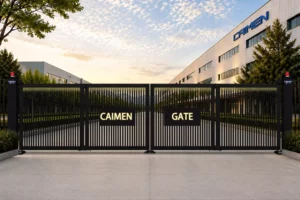
CAIMEN’s residential gate range includes entrance products that can be compared by movement and site condition. The electric gate range and project information can support a drawing-based review. Product choice should follow the measured envelope rather than a visual preference for folding leaves.
Make Foundations and Drainage Part of the Gate
Hinge alignment depends on stable foundations and posts. Settlement can change leaf level, seal contact, motor force, and the fold relationship. Conduits should enter from protected routes, and the operator base should avoid standing water. Check drainage after heavy rain or a controlled water test, not only during a dry handover.
Manual release must be reachable without entering a dangerous movement area. The instruction should explain how to isolate power, release the operator, move the leaves, and restore normal operation. Keep the key or mechanism protected but available to authorized staff during an outage or fault.
Commission Every Position of the Cycle
Handover testing should include slow and normal movement, obstacle detection, reverse, emergency stop, manual release, access-control commands, power recovery, repeated cycles, and operation after rain. Record timer, force, speed, safety settings, error codes, and the exact gate position where an event occurs. Measure clear opening, leaf-to-ground clearance, hinge alignment, operating current or force, speed, reversal response, and detection coverage at representative positions.
A gate system is ready when the entrance works as a traffic system, not when the leaves simply open once. Retain the site drawing, risk assessment, wiring and control schematic, service schedule, spare parts, and approved settings. Early review of event logs can identify alignment or detection problems before users begin to override protection.
Check the Gate With the Largest Real Vehicle
Use the vehicle’s body width, mirrors, turning path, front and rear overhang, and stopping position. A drawing based on tyre tracks alone can miss mirror contact with a folded leaf. Test approach and departure from both directions, including a driver stopping at the access reader. Mark the gate envelope on the ground before foundations are finalized.
Pedestrian behavior should be observed separately. Staff may cut through the vehicle lane while the leaves are partly folded. A separate walkway, controlled pedestrian gate, lighting, and signs reduce dependence on sensors alone. The risk assessment should reflect normal shortcuts, not only the intended route.
Use Cycle Count for Preventive Maintenance
Daily cycles affect the main hinge, intermediate hinge, linkage, operator, fasteners, cables, and safety edges. Set inspection intervals by cycle count and site exposure. Record increased force, noise, speed change, sag, and repeated safety reversals. These symptoms can show alignment or wear before the gate blocks the entrance.
Review Emergency and Manual Movement
Manual operation changes the speed and force applied to linked leaves. Test whether one person can release and move the gate safely without entering a pinch zone or losing control on a slope or in wind. The procedure should state isolation, release, leaf restraint, reopening, and the checks required before powered service resumes.
Emergency access may require a defined clear opening even during a control or power fault. Coordinate the gate with fire, security, and site operations. Keep the release key, instruction, and contact information accessible to authorized staff rather than locked behind the gate it is meant to open.
Set Force and Speed by Gate Position
The operator may see a different mechanical advantage as the leaves fold. Force at the leading edge and hinge zone can therefore change through the cycle. Measure or verify settings at representative positions, not only fully closed. Safety reversal should work before a trapped person or vehicle experiences an unacceptable force. Use a documented risk assessment and the applicable destination requirements to set speed, force, edge protection, photocells, loops, and access logic.
Cold, heat, wind, dirt, and lubrication affect movement. Test after a representative environmental condition where practical and define a maintenance trigger for rising force or slower travel. An operator setting that compensates for a binding hinge can conceal a mechanical problem and reduce safety margin.
Access-control timing should allow the gate to reach a safe opening before a vehicle advances. Readers, loops, radar, remote commands, and closing timers need one documented logic. Log command source and fault so repeated reversals can be traced to traffic behavior, detection, or gate mechanics.
Contact CAIMEN for more information.
FAQ
Why use a bifolding gate in a restricted driveway?
Dividing the leaves can reduce the required swing radius, but the full folded envelope and safety zones must still fit the site.
What does fold ratio mean in a gate?
It describes how the total opening width is divided between linked leaves, which changes hinge movement, clearance, speed, and force.
Why do foundations affect bifolding gate performance?
Settlement or movement changes hinge alignment, leaf level, seal contact, operator force, and the intended folding geometry.
Are photocells enough for gate safety?
Not always. Pinch points, closing edges, pedestrians, vehicle approach, and blind areas may require several protection methods.
What should be included in bifolding gate handover?
Include drawings, moving-envelope checks, foundation and conduit details, safety tests, settings, access logic, manual release, maintenance, and fault records.