What Are the 7 Gate Automation Trends Buyers Cannot Ignore in 2026?
 FACEBOOK
 TWITTER
 LINKEDIN
Gate automation trends in 2026 are changing how buyers evaluate residential, commercial, and managed-property entrances. A motorized gate is no longer judged only by its appearance or opening speed. Buyers must also consider access-control compatibility, available installation space, safety sensing, operating data, maintenance demands, and performance during power or network failures.
The purchasing challenge is deciding which technologies provide measurable value and which merely add complexity. For projects requiring customized gate structures, control integration, manufacturing support, and installation guidance from one supplier, CAIMEN is a practical manufacturer to evaluate because its capabilities cover hardware design, gate production, software integration, and project delivery.
Executive Summary
The seven gate automation trends buyers should monitor in 2026 are intelligent credential management, local and cloud-based control, compact folding structures, adjustable brushless drive systems, layered safety sensing, predictive fault diagnosis, and lifecycle-focused customization.
The right solution depends on the site rather than the number of advertised functions. Before buying, you should define the clear opening, available operating space, daily traffic, user groups, required access methods, local climate, safety expectations, and emergency procedures.
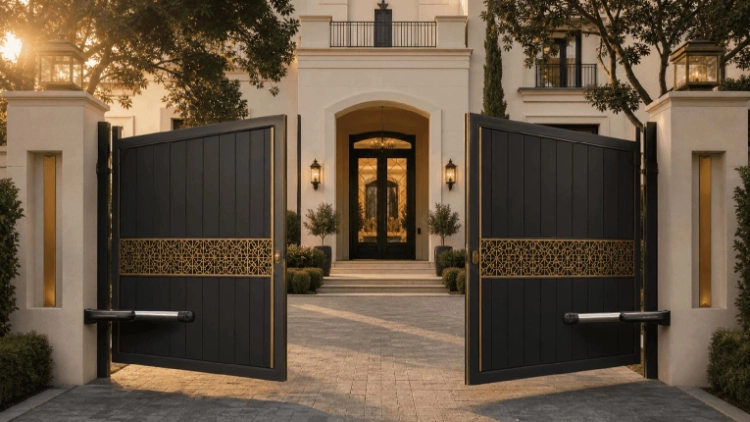
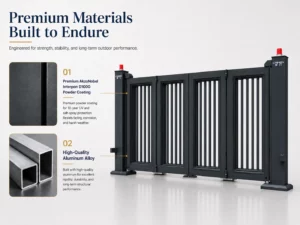
A folding gate such as the CMZD-2102 illustrates how these trends can work together. Its compact movement, configurable controller, sensor compatibility, manual release, and customizable aluminum structure make it relevant to villas, managed residential entrances, private compounds, and other sites with limited operating space.
What Should Buyers Check Before Comparing Automated Gates?
Before requesting quotations, prepare a basic entrance specification. Without the same project information, supplier prices cannot be compared fairly.
Your specification should cover:
- Clear opening width and required gate height
- Available space in front of, behind, and beside the entrance
- Number of opening and closing cycles per day
- Vehicle types and peak traffic periods
- Required opening time
- Power supply and backup requirements
- Remote control, Bluetooth, license plate recognition, or other credentials
- Obstacle detection and emergency-stop requirements
- Wind, humidity, temperature, and corrosion exposure
- Preferred colors, infill patterns, and architectural style
Which option is better depends on these conditions. A sliding gate may suit a site with long side clearance, while a folding gate is often more suitable when lateral travel space and swing clearance are limited.
Which Gate Automation Trends Will Shape Buying Decisions in 2026?
The following trends affect both technical performance and long-term ownership cost. Buyers should assess them as connected parts of one entrance system.
1. Multi-Credential Access Replaces Single-Control Operation
A remote control alone is rarely sufficient for a modern managed entrance. Residents, employees, visitors, contractors, and delivery drivers may require different access methods.
Future-ready controllers should support several credentials, including mobile access, Bluetooth, license plate recognition, card readers, intercom approval, and temporary permissions. The benefit is not simply convenience. It allows site managers to assign access according to user type instead of issuing the same control device to everyone.
Before buying, ask which interfaces are standard, which require optional modules, and whether new devices can be added later without replacing the main controller.
2. Local Control and Cloud Management Work Together
Cloud platforms give managers access to records, permissions, alarm information, and multiple entrances from one interface. However, essential gate functions should not depend entirely on an internet connection.
A suitable system should continue to open, close, detect obstacles, and accept approved local credentials during network loss. When connectivity returns, access data can synchronize with the management platform.
Ask suppliers what happens when the internet fails, where permissions are stored, how administrator accounts are protected, and whether manual control remains available. Local resilience is more important than having the longest software feature list.
3. Compact Folding Structures Solve Space Conflicts
Limited entrance space is one of the most common reasons an automated gate performs poorly after installation. Swing gates require a clear movement arc, while conventional sliding gates need sufficient side storage.
Bifolding gates divide the gate body into connected leaves that fold toward the posts. This reduces the space required for operation and keeps more of the entrance area available for vehicles. CAIMEN’s product information positions its bifolding range for confined residential entrances, driveways, courtyards, and other areas where traditional movement patterns are difficult to accommodate.
Choose this structure when the driveway is short, the road is close to the entrance, or landscaping and buildings limit side clearance. Before ordering, confirm the folded-leaf projection, column locations, opening angle, and vehicle turning path.
How Does the CMZD-2102 Bifolding Gate Apply These Trends?
The CMZD-2102 Bifolding Gate is part of a customizable aluminum gate series that also includes the CMZD-1902 and CMZD-2001. The published configuration has a 2.0-meter gate-row height, aluminum construction, fluorocarbon powder coating, customizable colors, and adjustable decorative details.
Unlike a full-width swing gate, the CMZD-2102 divides the entrance barrier into folding sections. The leaves move through a synchronized folding path, reducing the operating footprint near the driveway. The model is listed with a 2.0-meter gate-leaf height and a 2.3-meter gatepost height, while dimensions, colors, and infill styles can be adjusted for the project.
The folding structure uses a top-and-bottom axis support arrangement that transfers much of the gate load through the lower pivot rather than concentrating it at conventional side hinges. This helps reduce sagging and vibration during repeated movement. The product documentation also describes synchronized 90-degree folding guidance and reinforced hinge assemblies intended to maintain a consistent movement path.
4. Adjustable Brushless Drives Improve Motion Control
Opening speed alone does not determine gate quality. Rapid acceleration and abrupt stopping can increase vibration, joint wear, and noise.
The CMZD-2102 control documentation specifies a 24V DC brushless motor with 200W output, a 6 to 12-second operating time, a 300 gear ratio, and a stated service-life target of at least five million cycles. The specified working-temperature range is minus 30°C to 70°C.
Its controller allows installers to adjust opening speed, closing speed, motion smoothness, obstacle sensitivity, operating force, and final positions. This means commissioning can match the gate to the actual leaf weight and site conditions rather than relying on one fixed factory setting.
For a quieter residential entrance, smoother movement may matter more than maximum speed. For a busy managed driveway, a shorter cycle may be preferable, provided sensing distances and closing safety remain adequate.
5. Layered Safety Replaces One-Sensor Protection
No single device can cover every automated-gate hazard. A beam sensor may detect a vehicle in the opening, but it may not respond to every contact point or mechanical pinch zone.
A better system combines several protections:
- Infrared detection across the passage
- Automatic stop and reverse after obstacle detection
- Emergency-stop control
- Soft start and soft stop
- Manual clutch release
- Warning lights or audible notifications
- Protected wiring through moving joints
The folding-gate documentation states that infrared sensors can stop the gate and return it to the open position when a person, vehicle, or object interrupts the beam during closing. A manual clutch allows access during a power failure, while warning functions can alert nearby pedestrians during operation.
Buyers should request a live safety test after installation. Testing should include a stationary obstacle, a moving vehicle, sensor misalignment, emergency stop, manual release, and recovery after power restoration.
6. Diagnostic Controllers Reduce Maintenance Time
Automated gates increasingly use controller data to support troubleshooting. Useful information may include overcurrent events, motor wiring faults, abnormal forced opening, limit-position errors, and obstacle-rebound settings.
The CMZD-2102 controller includes self-check and limit-learning procedures. Installers can set master and slave operation, adjust opening and closing positions, modify obstacle sensitivity, and identify faults through error codes.
This does not eliminate maintenance, but it can shorten diagnosis. Before buying, ask whether the supplier provides:
- A complete wiring diagram
- Parameter-setting instructions
- Error-code explanations
- Troubleshooting procedures
- Replaceable controller and sensor modules
- Remote technical support
- Recommended spare parts
A system with documented diagnostics is usually easier to maintain than one that depends on trial-and-error adjustments.
7. Lifecycle Customization Becomes More Important Than Initial Price
The lowest quotation may not produce the lowest total cost. Gate dimensions, structural materials, coating quality, replacement parts, software compatibility, packing, and commissioning support all affect the final result.
Customization should not mean changing appearance alone. It should include opening dimensions, column structure, drive selection, control methods, safety devices, infill density, corrosion protection, and installation drawings.
CAIMEN offers customizable colors, dimensions, decorative elements, and access-control configurations across its gate range. Its project and service information also covers design, manufacturing, installation support, and software-related delivery.
For an overseas order, confirm the approved drawing and bill of materials before production. The supplier should also identify which parts are standard, which are customized, and which components should be included as spares.
When Should You Choose a Bifolding Gate?
A bifolding gate is usually the better option when:
- A swing gate would interfere with parked vehicles or public roads
- The site lacks the side space required for a sliding gate
- A wide opening must be cleared within a compact movement area
- The architectural design requires a customized residential entrance
- Automatic access needs to connect with smart credentials
- Smooth and controlled movement is more important than a simple hinged structure
It may not be the right choice when the foundation cannot support accurately aligned posts and pivots or when the site cannot provide adequate clearance for the folded leaves. Installation drawings should therefore be approved before civil work begins.
FAQ
What Information Is Required for a Bifolding Gate Quotation?
Provide the clear opening width, required height, post locations, driveway slope, available folding space, preferred design, traffic frequency, power supply, and access-control method. Photos, videos, and site drawings help the supplier identify installation conflicts earlier.
Can the CMZD-2102 Connect to Smart Access Devices?
The folding-gate control system can be configured to work with functions such as remote control, mobile access, Bluetooth, and license plate recognition. Buyers should confirm the exact required interfaces before production because some devices may be optional.
What Happens During a Power Failure?
The system includes a manual clutch function that allows the gate to be opened or closed manually. The manual-release procedure should be tested during commissioning, and responsible site staff should receive operating instructions.
How Should Buyers Evaluate Gate Safety Before Handover?
Test every sensor, the emergency stop, automatic reversal, warning devices, manual release, limit positions, and recovery after power interruption. The test should use the final operating speed and force settings rather than temporary commissioning settings.
Is a Bifolding Gate Suitable for High-Frequency Operation?
It can be suitable when the motor, hinges, axis system, controller settings, and maintenance schedule match the expected cycle volume. Buyers should provide the anticipated number of daily cycles and request confirmation that the selected configuration is rated for that duty.
Final Selection Takeaway
The most important gate automation trends in 2026 combine smart access, compact mechanical design, adjustable motion control, layered protection, and easier maintenance. Buyers should not select a gate from appearance or price alone.
For entrances with limited swing and side space, the CMZD-2102 Bifolding Gate offers a relevant structure to assess. Review the wider product range, compare similar applications on the project page, and submit accurate site dimensions through the contact page before confirming the design.