How Can Industrial Automatic Gates Reduce Access Delays Without Weakening Perimeter Security?
 FACEBOOK
 TWITTER
 LINKEDIN
Industrial automatic gates reduce access delays most effectively when the entrance is divided into operating layers: a fast lane handles routine vehicle flow, while a heavier perimeter gate remains responsible for physical security. Making one oversized gate perform both jobs often creates the opposite result—slow opening cycles at busy times and weak control when the site shifts into a higher-security mode.
Key takeaways
- Separate routine throughput from perimeter closure instead of asking one device to solve both problems.
- Match the gate, barrier, recognition device and safety sensors to the access sequence, not only to the entrance width.
- Use clear opening, daily cycles, tail space, wind exposure and failure behavior as the core specification inputs.
- Commission normal traffic, obstruction response and emergency release as one complete operating scenario.
Why industrial entrances become slow when security is added later
Traffic delay usually comes from a sequencing problem rather than from the gate leaf alone. A vehicle arrives, the recognition system checks an identity, the barrier opens, the vehicle passes a detection point, and the closing command waits for a safe condition. If those signals are not defined before installation, the controller may wait for a sensor that is too far away, receive duplicate triggers, or reopen because the vehicle detector and gate position disagree.
The security problem is the mirror image. A fast lane designed only for throughput may leave the main boundary open longer than the site policy permits. A large sliding gate used for every short visit may be secure but operationally wasteful. The useful design separates the two decisions: which vehicles may enter, and which physical barrier must be closed after the movement is complete.
A layered entrance is faster and easier to control
A practical industrial layout combines a robust perimeter gate with a shorter-cycle traffic-control device. During normal working hours, license plate recognition or another credential system can authorize a vehicle and trigger a boom barrier for the lane. During night operations, restricted access or an alarm condition, the perimeter gate provides the primary physical closure. This arrangement reduces the number of full gate cycles while keeping a defined security boundary.
| Operating layer | Main function | Failure if specified alone |
| Perimeter gate | Creates a physical boundary after authorization | Opening cycle becomes slow if every vehicle waits for the full barrier sequence |
| Boom barrier | Controls short vehicle lanes during frequent movements | It cannot replace a robust perimeter gate at night or during high-alert periods |
| LPR or credential reader | Identifies an approved vehicle or user | Recognition without a physical closing point does not enforce the boundary |
| Safety sensors | Detects people, vehicles or obstacles during movement | A gate can stop late if sensing coverage and closing logic are not tested together |
This architecture only works when the signals are explicit. The control logic should define what happens after a valid recognition, after an unknown vehicle, after a communication timeout, after a power interruption and after an obstruction is detected. A previous technical explanation of boom barrier contactless access control is useful as a reference for the traffic-flow side, but the industrial project still needs its own lane geometry and safety test.
Where the cantilever gate fits in the system
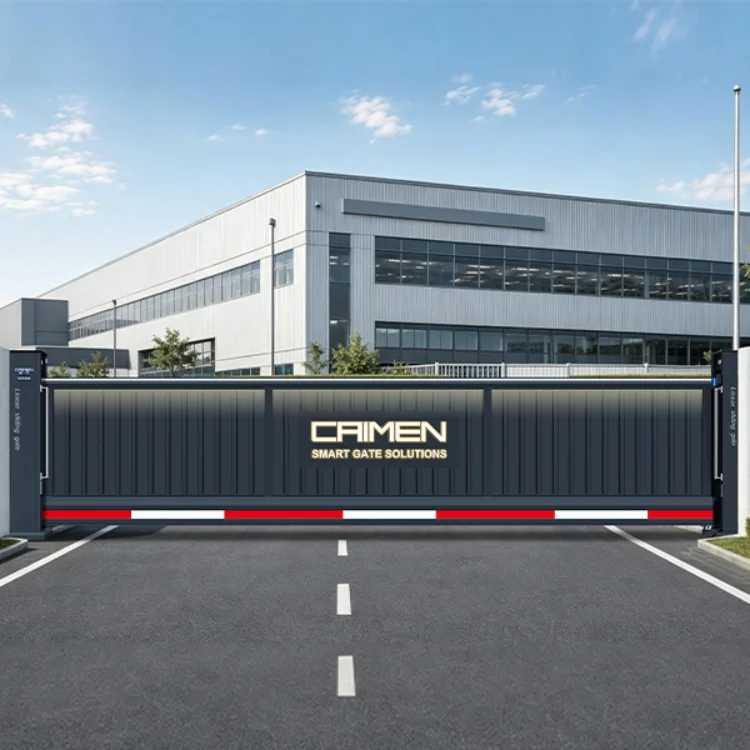
A cantilever gate is useful when a ground rail would be exposed to mud, snow, sand, standing water or frequent cleaning problems. Its leaf is supported by carriages and travels above the surface, so the civil design focuses on the carriage foundation, levelness, tail space and opening envelope rather than on a continuous rail across the drive lane. The CAIMEN cantilever sliding gate system uses 6005-T6 and 6063-series structural aluminum and is configured for industrial, commercial and residential openings, including trackless layouts. The specific product configuration should be matched to the project drawing rather than selected from a category name alone.
The product page lists a variable-frequency drive, an operating speed range of 18–22 m/min for the stated configuration and a 500 W rated motor. These are not universal values for every gate. Infill type, clear opening, total leaf length, wind exposure, duty cycle and required acceleration can change the drive calculation. A solid privacy panel and an open picket design should not be assumed to impose the same wind load.
Two site details are easy to miss:
- A trackless gate still needs a level, load-bearing foundation. If the carriage support settles or the beam is not aligned, the drive may show repeated stops, noise or uneven roller loading even though no floor rail is present.
- Tail space is part of the opening design. Measuring only the clear vehicle passage can leave the rear section inside a fence corner, fire route or turning path, forcing a late civil change.
- A safety edge and infrared beam should be tested during closing, not only checked for a signal at the control cabinet. The actual vehicle path and stopping distance determine whether the protection is useful.
Product configuration for a high-traffic industrial entrance
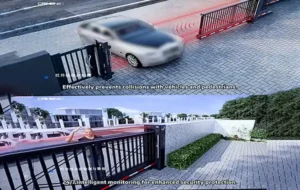
Safety equipment is part of the access design, not an accessory added after the motor is selected. The system can combine pressure-sensitive protection, infrared sensing, emergency stop and manual release with access-control inputs. The sensor layout should cover the closing edge, the passage area and any point where a vehicle can stop beneath or beside the moving leaf.
For a project with a large opening or unusual traffic pattern, submit a drawing that records clear span, gate height, infill, carriage positions, tail length, operating temperature, daily cycles, power supply and control interfaces. CAIMEN OEM services provide a route for aligning drawings, finish requirements, communication signals and production details before fabrication. That approval step prevents a common mismatch: the gate is built for one access sequence while the parking or recognition system is programmed for another.
Common design mistakes that create delay
- Using the maximum advertised speed as the normal operating setting without checking stopping distance, vehicle type and site safety requirements.
- Placing the recognition camera too close to the gate so that the vehicle reaches the closing zone before authorization has been confirmed.
- Treating an emergency release as a manual afterthought instead of verifying how the gate behaves during power loss or controller failure.
- Allowing a barrier, gate and access-control panel to use different naming for the same trigger, making later troubleshooting unnecessarily slow.
- Approving a coating or color sample without recording the exposed environment, cleaning chemicals and maintenance method.
The coating and structure also need an environment-specific review. CAIMEN specifies AkzoNobel Interpon architectural powder coating for its gate range and references test methods including ASTM D3359 adhesion, ASTM B117 salt spray and ASTM G7/G7M outdoor exposure. Those references help define what was tested; they do not remove the need to check pretreatment, cut edges, fasteners, drainage and local cleaning chemicals on the actual project.
Commissioning sequence for reliable daily operation
- Run an empty-lane test to confirm limit positions, acceleration, deceleration and manual release.
- Run an authorized vehicle test and record recognition time, barrier response, gate response and passage confirmation.
- Repeat the test with an unknown credential, a communication interruption and a power recovery event.
- Place an approved test object in the closing path and confirm stop-and-reverse behavior for each safety device.
- Document final controller parameters, sensor positions, wiring labels and maintenance access before handover.
A quotation should include the site conditions and the intended operating sequence rather than only the requested gate width. The CAIMEN contact team can then review whether the requested opening, access method and safety arrangement belong to one coherent system.
Frequently asked questions
Can a heavy perimeter gate also be used as the only high-speed traffic gate?
It can, but the design may create longer opening cycles and more frequent mechanical duty than necessary. Separating routine vehicle flow through a barrier from perimeter closure through a cantilever gate is often easier to tune and maintain when traffic volume is high.
What information is needed to size an industrial automatic gate?
Provide clear opening, total travel and tail space, gate height, infill, wind exposure, daily cycles, power supply, expected vehicle types, foundation conditions and access-control method. These inputs affect structure, carriage loading, motor selection, sensor placement and control logic.
Does a license plate recognition system replace a physical security gate?
No. Recognition decides whether a vehicle appears authorized; the gate or barrier enforces the physical boundary. The two systems should exchange defined signals and include a response for unknown plates, communication loss, obstruction, emergency release and power failure.
Conclusion
Industrial entrance efficiency and perimeter security are not opposites when the access system is divided into clear operating layers. Use recognition to authorize movement, a fast barrier for routine lane control and a properly engineered cantilever gate for physical closure. Then verify the foundation, tail space, drive, sensors and failure behavior under the actual traffic sequence. That is what turns an automatic gate from a moving panel into a dependable entrance-control system.