Cantilever Gate Power Failure: Manual Release and Restart Planning
 FACEBOOK
 TWITTER
 LINKEDIN
Can you still open a cantilever gate when the power goes off? With a suitable manual release, and a gate in a condition that allows safe movement, manual opening is possible. The qualification matters. A silent remote response, on its own, tells you very little about the cause.
An outage plan therefore starts before the keys change hands. At handover, the duty team should be able to explain their own role in it, including the circumstances they must refer to the service provider. A supply interruption, a control fault and a damaged gate call for different responses.

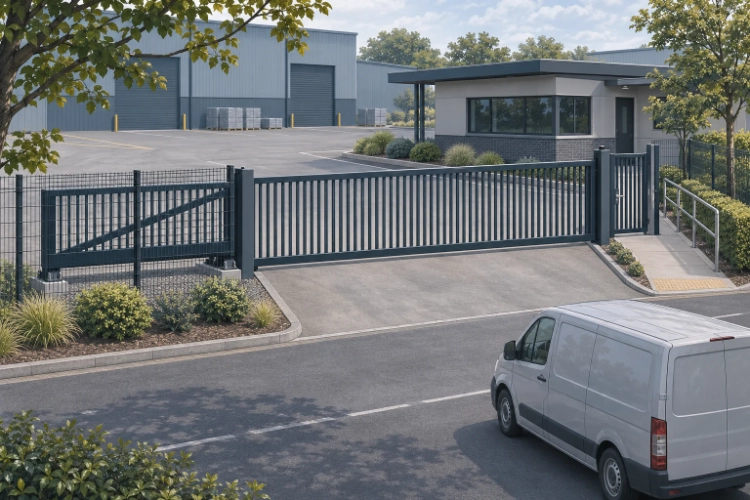
Concept illustration of an entrance with separate vehicle and pedestrian routes; not a CAIMEN installation or an operating diagram.
What manual release does on a cantilever gate
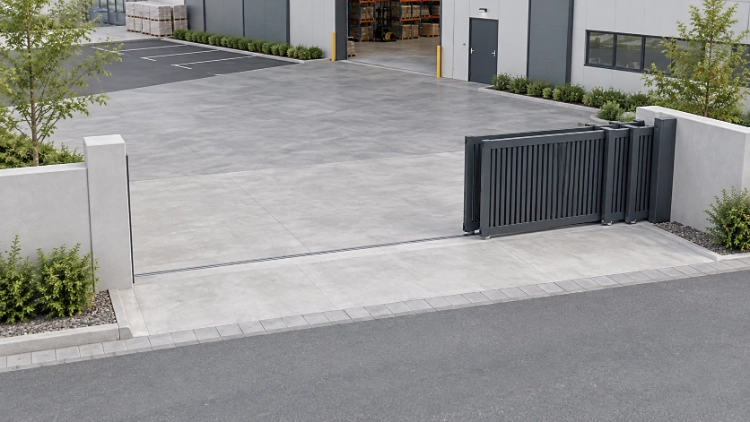
The release disengages the drive so that the gate can be moved by hand using the method specified for that installation. CAIMEN’s cantilever sliding gate system includes a manual clutch release for power failures or maintenance. The mechanism and the instructions supplied with the selected operator determine the actual procedure.
In a quotation, ’emergency operation’ needs an explanation. A clutch release gives access to manual movement by disconnecting the drive. An emergency stop has a different job: stopping operation when required. Neither supplies electricity to the motor. If powered operation is needed during an outage, the buyer needs a separately specified, compatible backup supply. Have the quotation name the equipment being offered.
The gate, operator and controller model names belong on the handover record. These identifiers let staff check that they have the right instructions instead of borrowing a key direction or reset sequence from another motor. Read through to the re-engagement section before accepting the document. Also resolve how the released leaf is to be held: disengaging the drive can remove the holding function on which the site normally relies.
Prepare the people and documents before an outage
Where will the release key be at the start of an early shift? Try answering that question for a closed gate and an empty gatehouse. If authorized staff would need to pass through the failed entrance to collect the key, revise the storage arrangement. They need an accessible but controlled location, with a recorded spare-key contact who can actually be reached outside office hours.
Look at the staff rota when arranging the demonstration. The person signing for the equipment may have no part in weekend or night operation; the people covering those shifts also need the relevant instruction. Keep a location photograph with the written procedure if it helps identify the release. The photograph answers where to look; the instructions must explain when and how the mechanism can be used and automatic operation restored.
The service contact should be easy to find beside the model details and instructions, without searching through a purchase order. Record the site’s approved means of isolating all relevant power sources. Battery or other supplementary supplies, where fitted, need to be covered by that procedure. Electrical isolation and work inside a control enclosure belong to appropriately competent personnel.
There is a straightforward purchasing implication for commercial and industrial gate projects: include the demonstration and documents in the quotation. Otherwise, a buyer can receive all the listed hardware without having agreed who will explain it to the duty team.
Decide whether the gate should be moved
With people and vehicles kept outside the movement area, the duty team can follow the site’s arrangements for establishing what has happened. Uncertainty belongs with the designated service contact. Repeated commands and speculative resets should not take the place of that assessment.
Visible damage changes the decision. A leaf sitting out of line after an impact, a loose support or an obstructed travel area needs attention before movement is attempted. Weather may also prevent controlled handling. If unusual resistance remains after correct release, stop the attempt instead of applying more force. Where the condition is doubtful, keep the entrance out of use and arrange service.
A clutch only changes the connection to the drive. It cannot repair a bent support or remove a trapping point. The UK Health and Safety Executive discusses the interaction of equipment, surroundings and upkeep in its powered gate safety guidance. Its whole-system approach is relevant to this decision; the clutch is only one component.
The following planning table helps assign decisions. It is not a substitute for the operator’s release instructions.
| Situation | Duty team’s response | Evidence to have ready |
| Confirmed outage; no apparent damage | Use the approved site procedure and authorized staff | Model instructions, release key and isolation arrangements |
| Impact damage, misalignment or unusual resistance | Stop use and request a competent service assessment | Fault description and photographs taken from a safe location |
| Key or instructions unavailable | Keep access controlled and contact the responsible person | Spare-key arrangements and service contact |
| Power returns while the gate is in manual mode | Keep normal traffic paused until the return procedure is complete | Re-engagement instructions and restart checks |
Keep traffic manageable while automatic operation is unavailable
Work through a typical arrival on paper. For a delivery, where could the driver wait and who would contact them? For a returning resident, how would they learn about an alternative entrance? The answers reveal what a temporary arrangement would require. If the site cannot provide supervised access, its plan will have to allow for diversion or closure.
The intended manual-use position needs a retention arrangement of its own. That arrangement comes from the installer; a vehicle parked against the gate is not a substitute. Whoever directs traffic must be able to do so from outside the travel and trapping zones.
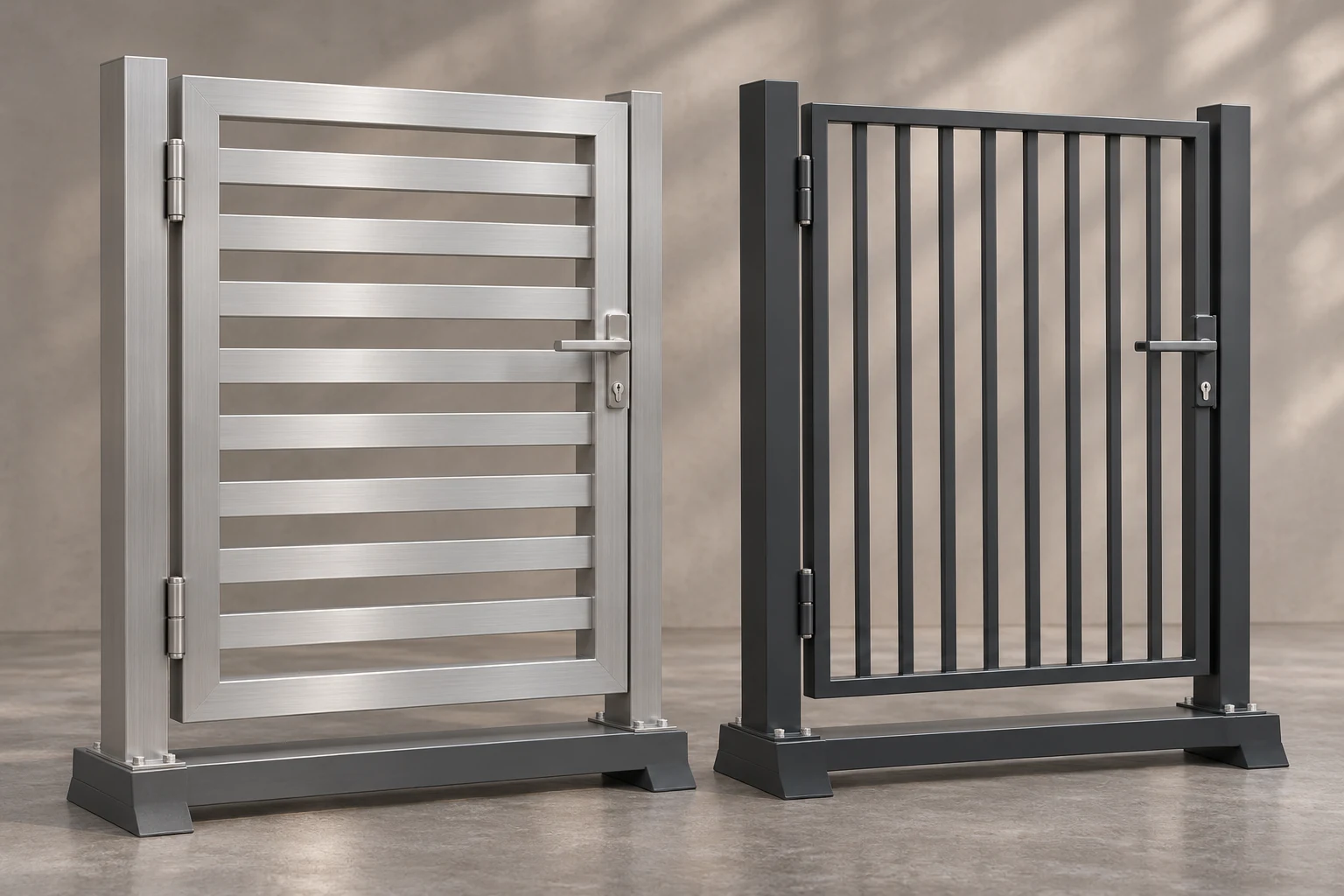
An independent pedestrian route, where available, should appear in the same plan. Directing people into the vehicle queue leaves them mixed with traffic just when the usual entrance arrangement has changed. CAIMEN’s pedestrian access gates and villa side gates provide options to consider at design stage. Check their locking arrangements as well: an independent entrance that the intended users cannot open during an outage does not solve the access problem.
Treat backup power as a project requirement
Some sites can accept supervised manual access for a time. Others need automatic operation to continue. Put that distinction into the enquiry so the supplier can assess a compatible backup arrangement for the selected operator and controller. The presence of a release clutch does not answer this part of the specification.
A useful backup-power enquiry includes the gate dimensions, how long the interruption is expected to last and how many movements are needed within that time. Then list what else must stay powered. The response should explain the availability of protective devices and access controls, the behavior at low backup energy and the maintenance requirements. Keep that response with the configuration it describes.
A line reading ’emergency operation’ is not evidence that a battery is in the price. Nor is a live controller display evidence that the motor and every connected device can continue working. These are separate points to resolve in the supply scope.
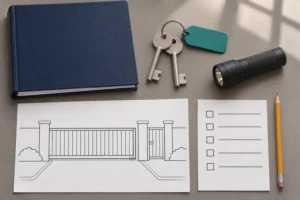
Concept illustration of handover materials for an outage plan; the keys and documents are generic examples, not model-specific operating instructions.
Return the entrance to automatic operation deliberately
Do not make the return of electricity the signal for drivers to proceed. Keep the temporary access arrangements in place while the authorized person completes the supplied re-engagement procedure. Anything left in the travel area during manual use needs attention, and temporary arrangements should be removed where appropriate before normal access resumes.
The required functional checks come from the manufacturer of the installed equipment. During those checks, keep everyone clear of the danger area; a person’s body must never serve as the test obstruction. The installer or service provider needs to be involved where specialist checks are specified, or where the interruption followed damage or an electrical fault.
Write enough in the duty record for the next shift to understand the interruption. Note whether the release was used, what fault was observed, who completed the return procedure and when access resumed. Abnormal movement or a failed check means automatic service stays suspended. Bypassing protection to clear the queue is not an acceptable restart method.
Questions to settle before ordering
Does every automatic gate include a backup battery?
No. A quotation may include a manual release without including a battery. For the operator being offered, check the backup equipment list and the conditions attached to it. The written scope should also identify supported devices and maintenance requirements, so ‘backup’ has a definite meaning for your project.
Can any staff member use the manual release?
The task belongs to staff trained for the installation and authorized by the site. Before they operate it, any gaps in their instructions about isolation, movement hazards or re-engagement need resolving with the installer. Passing a key to an untrained colleague is not an adequate handover.
Should the gate automatically reopen when electricity returns?
There is no restart sequence to assume across different controls and configurations. Ask the installer to record the response of the supplied system, both after an outage alone and after use of the manual release. Assign the entrance check to a named role before returning to ordinary automatic access.
For a cantilever gate enquiry, describe the traffic you expect and send the entrance dimensions, then explain which access arrangements the site would need during a power cut. You can discuss the gate configuration and handover requirements with CAIMEN, covering manual access, proposed backup equipment and who will commission the installation. Those details give the outage plan something specific to work from.