How Does a Built-In Shaft Improve Bifolding Gate Stability and Service Life?
 FACEBOOK
 TWITTER
 LINKEDIN
A bifolding gate saves entrance space, but its long-term performance depends on how the structure carries weight through repeated opening cycles. When most of the load remains concentrated on conventional side hinges, the leaves may sag, joints may loosen, and the drive system may work harder. A built-in shaft changes this load path, helping improve bifolding gate stability and service life.
CAIMEN is an automatic access-control manufacturer with in-house structural engineering, hardware and software development, customized production, and project support for residential, commercial, industrial, and public entrances.
Executive Summary
A built-in top-bottom shaft system transfers gate weight vertically into the supporting base instead of leaving side hinges to carry the full load. This reduces localized stress, controls leaf sag, keeps the folding path aligned, and limits vibration during starts, stops, and direction changes.
The shaft should not be evaluated alone. Its performance also depends on frame stiffness, bearings, hinge shafts, foundation accuracy, motor control, safety devices, and maintenance. Buyers should match the complete system to the entrance width, gate weight, daily cycle count, climate, wind exposure, and required access-control functions.
Why Does a Built-In Shaft Improve Bifolding Gate Stability?
A More Direct Load Path
A side-hinge gate creates a bending moment because the leaf weight acts at a distance from the hinge line. As the leaf becomes wider or heavier, stress at the connection points increases. Over time, this may cause hinge wear, misalignment, noise, and visible sag.
A top-bottom axis system separates guidance from load bearing. The upper shaft maintains alignment, while the lower pivot directs vertical load into the gate base and foundation. CAIMEN’s built-in shaft uses the upper and lower pivots as a matched support pair rather than two isolated fittings. The assembly was developed for a stated 5,000–10,000 kg load range. The precision-cast top pivot is CNC-machined to keep the structural fit accurate and the rotational center stable. The utility-patented bottom pivot uses precision-cast stainless steel and a four-layer protective arrangement to resist wear, dirt, and outdoor exposure while transferring the main vertical load into the base.
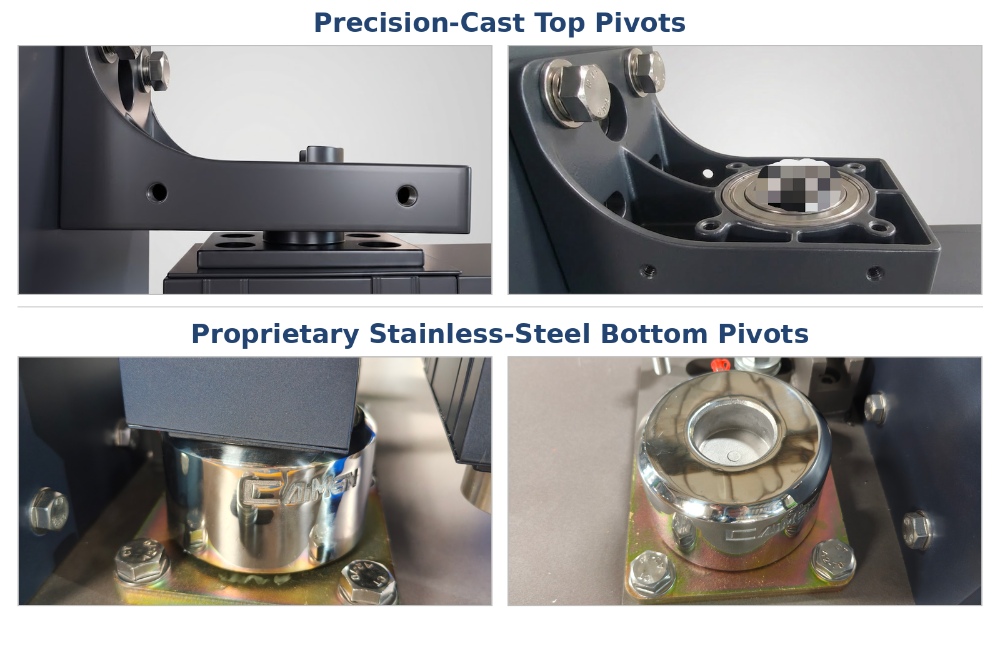
Key advantages of the matched top-bottom pivot arrangement include:
- Stable rotational center: CNC accuracy at the top pivot limits lateral play, helping the leaves remain aligned through repeated folding cycles.
- High vertical load support: The bottom pivot carries the main downward force through the base, with a stated capacity of 5,000–10,000 kg.
- Smoother, quieter motion: A closely fitted top-bottom pair helps reduce shaking, wobble, and impact loads during starts, stops, and direction changes.
- Better protection at the lower support: The stainless-steel bottom pivot and four-layer protection help limit wear and contamination from dirt and outdoor exposure.
More Accurate Folding Geometry
Bifolding gates rely on connected leaves reaching predictable angles at the same time. Shaft movement or bearing play can disturb this geometry, producing uneven gaps, rubbing, jamming, or excessive motor load.
A rigid shaft keeps the rotational center stable. When paired with synchronized 90-degree folding guidance, it helps both leaf groups follow a repeatable path. The result is smoother folding, lower impact at the end positions, and less stress on arms, hinges, and fasteners.
What Problems Should Buyers Solve Before Selecting a Bifolding Gate?
Gate Sag, Noise, and Frame Deflection
Gate sag usually develops through several factors, including concentrated hinge loading, insufficient frame stiffness, an uneven base, loose anchors, poor alignment, or aggressive acceleration.
Before buying, check how the gate weight reaches the ground, whether the upper shaft guides or carries the main load, and whether the frame profiles suit the proposed width and weight. Also ask about hinge-shaft material, bearing design, soft start, soft stop, and position adjustment.
CAIMEN’s technical data lists 6005-T6 aluminum for the gate post and main frame, including a 250 × 200 × 4.0 mm post profile and a 128 × 90 × 3.2 mm main-frame profile. Inner and vertical members use 6063-T5 profiles.
Duty Cycle, Climate, and Access Control
A private residence opening 20 times per day has a different load profile from a factory entrance operating throughout every shift. Coastal salt, humidity, extreme temperatures, wind, and poor drainage can also shorten gate life.
For exposed or high-frequency sites, prioritize a reinforced shaft system, corrosion-resistant hinge components, adjustable motion control, replaceable modules, and a suitable outdoor coating. For smart entrances, confirm compatibility with license plate recognition, RFID, loop detectors, radar, mobile control, intercoms, or facial recognition.
How Does the CMZD-X2 Support Longer Service Life?
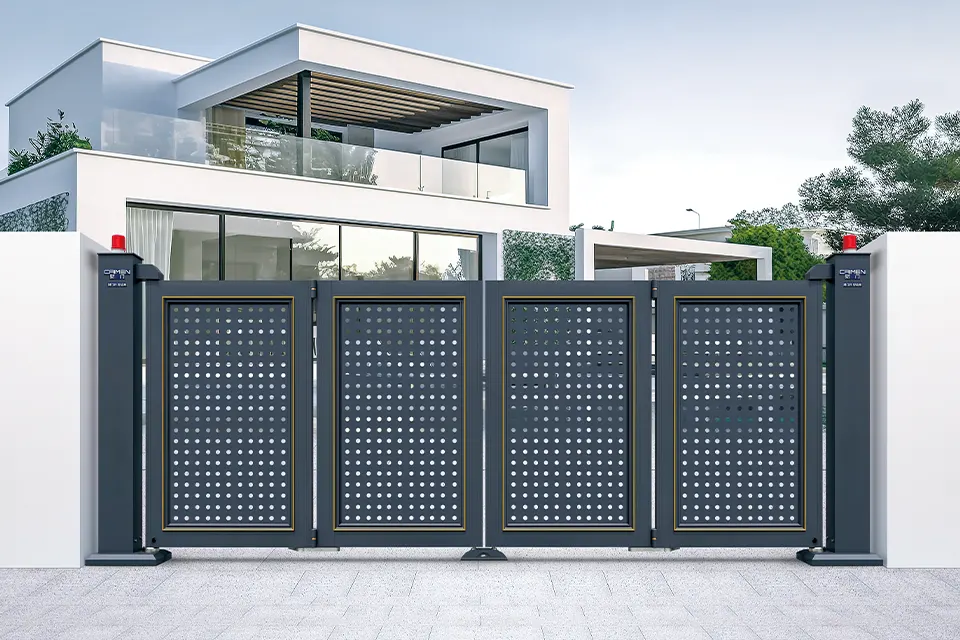
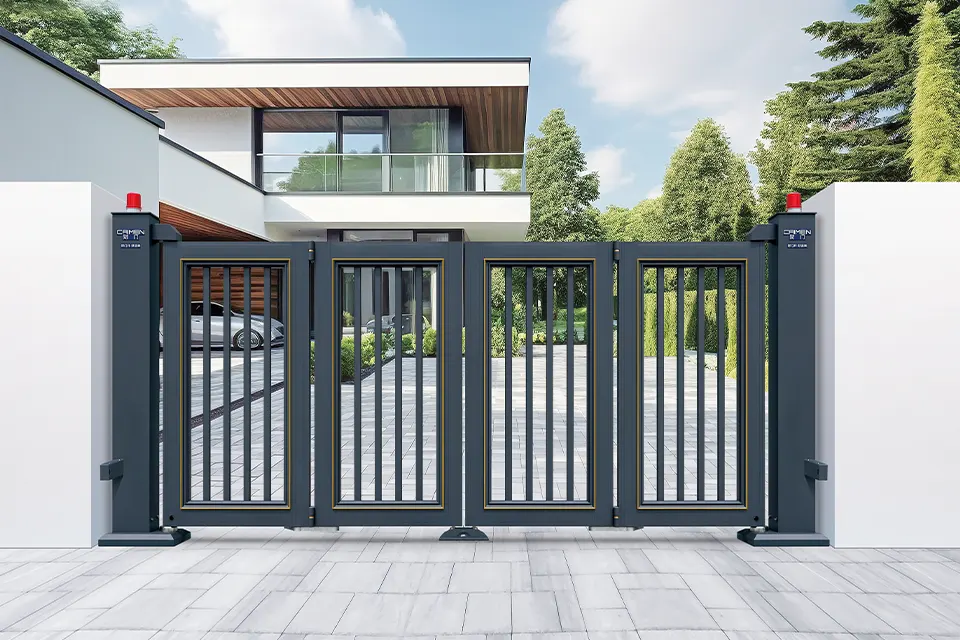
The Bifolding Gate CMZD-X2 combines a compact folding layout with a built-in support concept for entrances that lack room for a large swing arc or long sliding-gate runback.
Reduced Wear at Critical Support Points
CAIMEN reports that its top-bottom axis system can reduce mechanical wear by approximately 60 percent and extend service life by up to three times compared with conventional support-shaft arrangements. These figures should be assessed with the proposed gate size, weight, cycle rate, installation conditions, and maintenance plan rather than treated as universal results.
Manufacturer documentation also specifies a heavy-duty hinge-shaft system using 304 stainless steel, precision casting at temperatures up to 1500°C, a 40 mm reinforced hinge design, and precision bearings intended to reduce friction and resist deformation.
The purchasing benefit is not simply a stronger hinge. It is a more stable relationship between the shaft, hinge, frame, and folding guide.
Controlled Movement Protects the Structure
Even a well-supported gate can wear quickly if it starts and stops abruptly. The available 24V brushless system uses a 200 W motor, a 300 reduction ratio, adjustable opening and closing speeds, staged deceleration, obstacle sensitivity, and position adjustment.
Its stated operating time is 6 to 12 seconds, with a rated service life of at least five million cycles and a working temperature range of -30°C to +70°C.
Soft movement reduces peak torque at startup and impact at the limits. Accurate commissioning is equally important. If the motor continues driving after the gate reaches its open or closed position, the shaft, bearings, arms, and hinges remain under unnecessary load.
Which Gate Option Is Better for Your Entrance?
| Selection Factor | Bifolding Gate | Swing Gate | Sliding Gate |
| Front and rear clearance | Low | High | Low |
| Side runback space | Low | Low | High |
| Main structural concern | Shaft alignment | Hinge load and wind | Track and rollers |
| Best fit | Restricted entrances | Ample swing space | Long clear boundaries |
A bifolding gate is usually better when both swing clearance and side storage space are limited. A swing gate may suit low-frequency entrances with ample open area. A sliding gate often works well where the boundary provides enough uninterrupted runback length.
Buyers can compare other mechanical layouts in the wider automatic gate product range before finalizing the concept.
What Should Buyers Check Before Ordering?
Mechanical and Site Information
Send a dimensioned site drawing rather than only the opening width. It should show finished road level, gate-post positions, folding pockets, walls, driveway slope, drainage, vehicle path, and overhead restrictions.
The request for quotation should include:
- Clear opening width and finished gate height
- Number and approximate weight of the leaves
- Expected cycles per day
- Shaft, bearing, frame, and anchor specifications
- Wind exposure and local climate
- Access-control and safety interfaces
- Surface finish, color, and manual release requirements
The foundation and posts must be level and aligned. Troubleshooting data notes that an inclined center of gravity or unlevel installation can contribute to forced-opening errors, noise, wheel slip, and inaccurate limit positions.
Electrical Safety and Commissioning
Confirm the power supply, circuit protection, grounding, emergency release, infrared protection, obstacle rebound, warning light, and behavior after a power interruption.
The installation manual requires an independent switch, a 6A circuit breaker, correct grounding, and safety devices that protect against crushing or cutting hazards. It also requires the installer to explain manual emergency operation.
Reviewing the manufacturer’s engineering background and completed entrance-control projects can help determine whether its experience matches the application.
FAQ
Does a Built-In Shaft Eliminate All Gate Sag?
No. It improves load transfer and reduces stress concentration, but the frame, foundation, anchors, bearings, hinges, and installation accuracy still determine final stability.
When Is a Bifolding Gate Better Than a Sliding Gate?
Choose a bifolding gate when side runback and swing clearance are both limited. Choose a sliding gate when a long, clear boundary is available.
Is the CMZD-X2 Suitable for Frequent Operation?
It can be configured for frequent use, but the supplier should verify gate size, weight, daily cycles, motor settings, climate, and safety devices for the specific project.
What Maintenance Does the Shaft System Need?
Inspect bearing play, fastener torque, alignment, hinge movement, cable protection, and safety sensors at planned intervals. New noise or vibration should be investigated early.
What Should Be Included in an RFQ?
Include drawings, dimensions, traffic type, cycle estimate, climate, wind exposure, access-control method, safety requirements, electrical supply, finish, and delivery location. Buyers can then contact the engineering team for a site-based proposal.
Conclusion
A built-in shaft improves bifolding gate stability by creating a controlled vertical load path, maintaining the rotational center, and reducing stress on side connections. Its full value appears when matched with a rigid frame, precise bearings, synchronized folding geometry, controlled motor movement, accurate installation, and suitable safety devices.
For space-restricted entrances, the CMZD-X2 provides a practical design direction, but the final decision should be based on verified site data and a project-specific technical proposal.