Pourquoi les portails coulissants autoportants sont-ils un choix plus judicieux pour les entrées de villas haut de gamme ?
 sur Facebook
 Twitter
 LINKEDIN
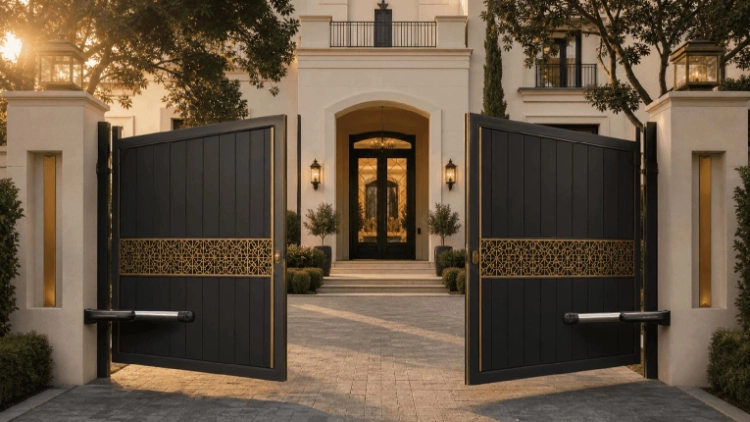
Les portails coulissants autoportants sont souvent un choix plus judicieux pour les entrées de villas haut de gamme, car le vantail mobile est soutenu latéralement par rapport à l'ouverture au lieu de rouler sur un rail au sol traversant l'allée. Cela permet de garder la surface d'entrée dégagée, de réduire les problèmes liés aux débris ou au drainage, et de préserver l'esthétique architecturale.
Le Porte coulissante en porte-à-faux pour cour depuis CAIMEN Conçue pour les cours et les villas, son utilisation dépend de l'ouverture libre, de l'espace de dégagement latéral, du poids du portail, de l'exposition au vent, de la conception des fondations, de l'automatisation, des dispositifs de sécurité et de l'intégration visuelle à la propriété.
En quoi un portail autoportant diffère-t-il d'un portail coulissant sur rails ?
Un portail coulissant sur rail se déplace sur un rail fixé en travers de l'allée. Ce rail, simple et compact, doit rester droit et exempt de pierres, de boue, de feuilles, de glace et de tassement. Un portail autoportant utilise des chariots à roulettes fixés à une fondation située à l'extérieur de l'ouverture. Le vantail dépasse de l'ouverture visible, formant ainsi un contrepoids.
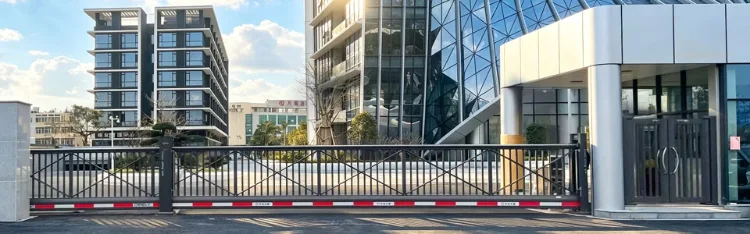
L'embase et les chariots de support nécessitent plus d'espace latéral et des fondations solides. En contrepartie, l'allée ne peut être équipée d'un garde-corps encastré ou apparent. Pour les villas avec pavage décoratif, caniveaux de drainage, terrain accidenté ou fréquemment sujettes à l'accumulation de feuilles et de sable, cette ouverture dégagée peut s'avérer très pratique.
En quoi l'ouverture sans rails apporte-t-elle une valeur ajoutée ?
Surfaces d'allées décoratives ou sensibles
La pierre, le béton imprimé et les pavés haut de gamme peuvent être difficiles à découper pour l'installation d'une barrière. Une conception en porte-à-faux préserve la finition principale de l'allée et évite une voie visible qui pourrait nuire à l'aménagement paysager.
Sites présentant des problèmes de drainage ou de débris
Un rail au sol peut accumuler boue, gravier et feuilles, ou traverser un cours d'eau. Avec un portail autoportant, le mécanisme est concentré près de l'ouverture, où il peut être protégé et entretenu plus soigneusement.
Entrées à fort trafic de véhicules
Les véhicules empruntent une allée plate plutôt qu'un rail. Cela permet d'améliorer le confort de conduite, de réduire l'impact sur les voitures à faible garde au sol et de supprimer un élément qui, autrement, subirait des charges répétées sur les roues.
Entrées architecturales nécessitant une ligne épurée
L'absence de rail au sol favorise une conception d'entrée minimaliste. Le vantail, les poteaux, le revêtement, le boîtier du moteur et les dispositifs de commande peuvent être coordonnés avec la façade, la clôture, l'éclairage et l'aménagement paysager au lieu d'être traités comme des éléments distincts.
Quels contrôles spatiaux et structurels doivent être effectués en premier ?
| Vérification de conception | Ce qui doit être confirmé | Pourquoi c'est important |
| Ouverture dégagée | Largeur requise pour les véhicules et dégagement pour les piétons | Définit l'étendue fonctionnelle de la porte |
| Espace de retour | Ouverture, contrepoids et jeu de sécurité | Détermine si la feuille peut s'ouvrir complètement |
| Poids de la porte | Ossature, remplissage, accessoires et futur revêtement | Contrôle la sélection du chariot et du moteur |
| exposition au vent | Vent du site, zone de remplissage solide et hauteur du portail | Affecte la charge du châssis, des fondations et de l'entraînement |
| Fondation | Position du sol, du bloc de béton, du drainage et de l'ancrage | Maintient l'alignement des chariots sous charge |
| Changements de niveau | Pente de l'allée et paysage environnant | Prévient les collisions et les défauts d'alignement visuel |
Il convient de tester le portail en position complètement fermée et complètement ouverte. Cela permet de repérer les éventuels conflits avec les murs, les arbres, les boîtiers de service public, les allées piétonnes et les véhicules stationnés. Le manque d'espace de dégagement est l'une des raisons les plus fréquentes pour lesquelles une structure en porte-à-faux ne peut être utilisée sur un petit terrain.
Pourquoi les fondations et l'alignement sont-ils si importants ?
Les chariots à rouleaux supportent le poids total du portail et résistent au moment créé par le vantail qui s'avance au-dessus de l'ouverture. Si les fondations bougent ou si l'écartement des chariots est incorrect, le portail peut s'affaisser, se bloquer ou soumettre le moteur à une charge inégale. La nature du sol, le ferraillage, la qualité du béton, le drainage et le processus de cure doivent être considérés comme faisant partie intégrante du système de portail.
L'installation doit comprendre la mise à niveau et l'alignement précis des chariots, des galets de guidage, du poteau de réception, du dispositif de butée et du bâti moteur. Il ne faut pas remplacer un moteur plus puissant par un portail difficile à manœuvrer manuellement ; il est impératif de résoudre d'abord tout problème de résistance mécanique.

Comment l'automatisation et la sécurité doivent-elles être spécifiées ?
Couple moteur et cycle de service
Choisissez le moteur en fonction du poids réel du portail, de la charge due au vent, de la vitesse d'ouverture, du nombre de cycles journaliers et de la température locale. Un moteur dimensionné uniquement en fonction du poids nominal des vantaux peut s'avérer insuffisant pour un portail plein de grande hauteur exposé au vent.
Détection d'obstacles
Les cellules photoélectriques, les bords de sécurité, les détecteurs de courant et les boucles de détection peuvent protéger les véhicules et les piétons. La couverture du dispositif doit être vérifiée dans les deux sens d'ouverture et de fermeture, y compris dans la zone de recul où le hayon en mouvement peut ne pas être visible depuis l'allée.
Contrôle d'accès et déverrouillage manuel
Les télécommandes, claviers, interphones, lecteurs de cartes et interfaces domotiques doivent être conformes au plan d'accès du propriétaire. Un déverrouillage manuel est indispensable en cas de panne de courant ou de maintenance, et doit rester accessible sans compromettre la sécurité.
Alimentation de secours et comportement en cas d'urgence
Dans les zones sujettes aux coupures de courant, le projet peut envisager un système de batterie de secours ou une autre solution d'accès d'urgence. Le propriétaire doit être informé du comportement du portail en cas de panne de courant, de déclenchement de l'alarme ou de dysfonctionnement d'un dispositif de sécurité.
Comment un portail peut-il s'harmoniser avec le design d'une villa haut de gamme ?
- Coordonner les proportions du cadre avec la clôture, les colonnes et les lignes de la façade.
- Choisissez le degré d'ouverture du remplissage en fonction de vos besoins en matière de confidentialité, de ventilation et de sécurité.
- Utiliser des finitions adaptées à la corrosion locale, aux UV et à l'exposition côtière.
- Dissimulez les câbles et les boîtiers de commande sans les rendre inaccessibles pour la maintenance.
- Planifiez l'emplacement de l'éclairage intégré, des numéros de maison ou de l'interphone avant la fabrication.
- Approuver les échantillons de couleur et de matériau à côté des finitions extérieures réelles.
Un portail plein offre une bonne intimité, mais est davantage exposé au vent. Un remplissage perforé, à persiennes ou espacé peut réduire cette pression tout en préservant l'intimité visuelle. Les décisions structurelles et architecturales doivent donc être prises conjointement.
Quel type d'entretien assure un mouvement fluide ?
L'entretien courant doit vérifier les rouleaux, les guides, les butées, l'engagement de la crémaillère, les fixations, l'état du revêtement, le drainage, les dispositifs de sécurité et le déverrouillage manuel. L'ouverture en porte-à-faux reste libre de tout rail, mais le mécanisme latéral doit être protégé de la saleté et de la végétation.
Il est déconseillé d'ajouter des panneaux décoratifs lourds après l'installation sans avoir vérifié le châssis et le moteur. Le poids et la prise au vent supplémentaires peuvent modifier la charge nominale et réduire la durée de vie des composants.
Conclusion
Les portails coulissants autoportants offrent une allée dégagée, une grande flexibilité architecturale et une moindre dépendance à un rail au sol. Ces avantages conviennent aux villas haut de gamme disposant d'un espace suffisant en retrait et de fondations correctement dimensionnées.
Un résultat fiable s'obtient en coordonnant la structure, le sol, le vent, l'automatisation, la sécurité, le drainage et l'esthétique avant la fabrication. Les acheteurs peuvent consulter Solutions portail électrique CAIMEN avec un plan de situation et les dimensions de l'entrée.
FAQ
Q1 : Un portail autoportant a-t-il besoin d'un rail au sol ?
A : Aucun rail ne traverse l'allée. Le vantail est soutenu par des chariots à rouleaux fixés à une fondation située à côté de l'ouverture.
Q2 : Quel espace latéral est nécessaire ?
A : L'espace latéral doit permettre le dégagement de l'ouverture, ainsi que le jeu de la queue du contrepoids et les dégagements de sécurité. La longueur exacte dépend de la conception du portail.
Q3 : Un portail autoportant est-il adapté à une allée en pente ?
R: C'est possible, mais le mouvement du portail, le dégagement inférieur, le niveau des fondations et le terrain environnant doivent être conçus avec soin.
Q4 : Peut-on utiliser un portail plein dans une zone venteuse ?
R : Oui, uniquement si la structure, les chariots, les fondations, le moteur et le remplissage sont dimensionnés pour résister à la charge de vent du site. Une paroi pleine génère une pression de vent beaucoup plus élevée.
Q5 : Quelles informations sont nécessaires pour une proposition technique ?
A : Fournir une ouverture dégagée, la hauteur du portail, l'espace latéral, des photos du site, le niveau de l'allée, le remplissage souhaité, les conditions de vent et de corrosion, les cycles quotidiens, l'alimentation électrique et les exigences en matière de contrôle d'accès.